
ADHD Assessments: How to Get Evaluated for ADHD in British Columbia
If you have been wondering whether ADHD might explain some longstanding challenges, or if you are a parent noticing signs in your child, the first hurdle is often just figuring out where to start. British Columbia has both public and private assessment paths, several types of professionals who can diagnose, and a lot of information online.
Here is a clear walkthrough of how the process actually works in BC, so you can take the next step with more confidence.
Who can do an ADHD Assessment in British Columbia
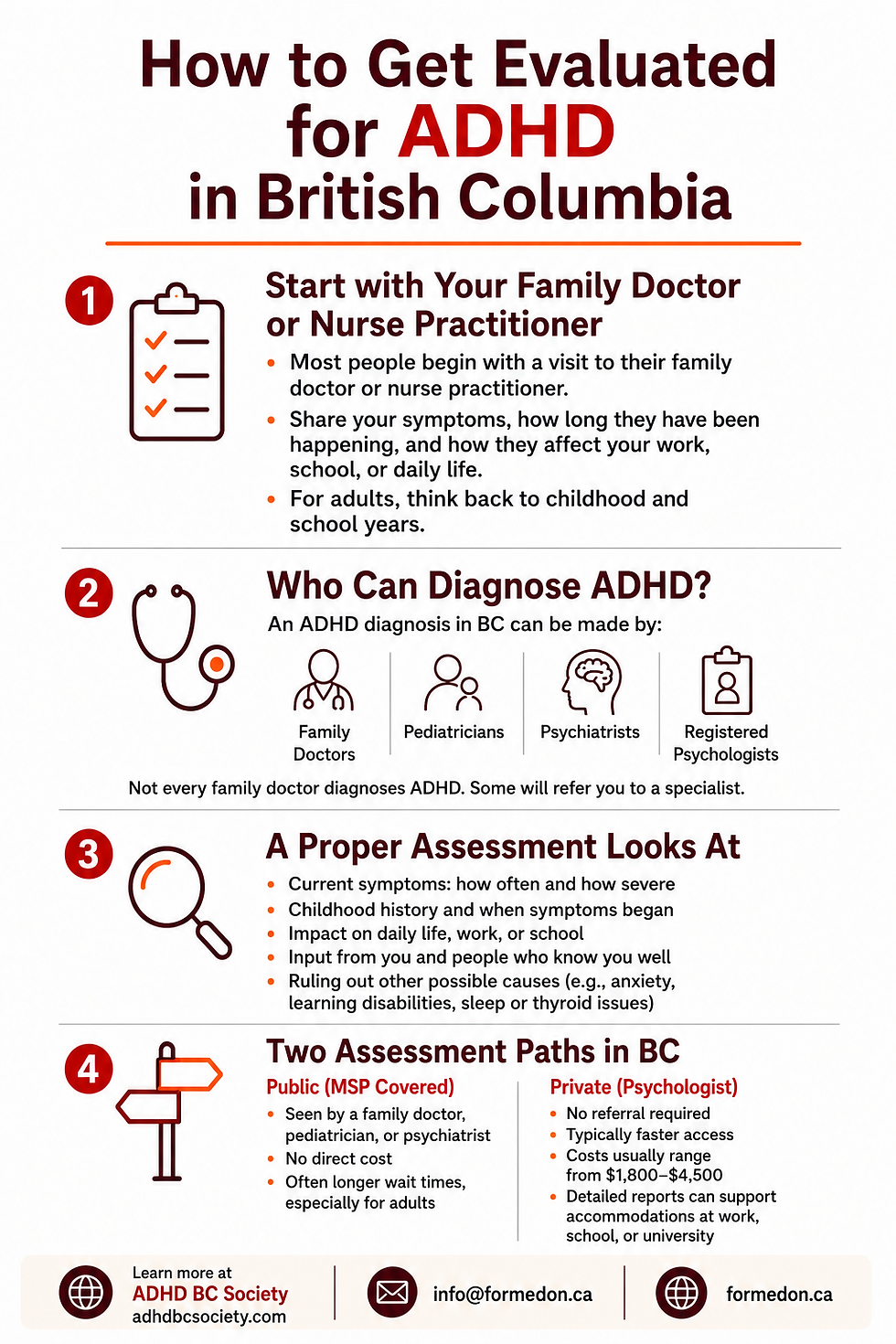
In British Columbia, an ADHD diagnosis can be made by a physician (such as a family doctor, paediatrician, or psychiatrist) or by a registered psychologist. This is confirmed by the ADHD BC Society, which is one of the most reliable local sources on this topic.
Not every family doctor will feel comfortable diagnosing ADHD themselves, especially for adults, where the picture can be more complex. Some will diagnose and treat directly. Others will refer to a specialist.
Where most people start
For both adults and children, the usual starting point is a visit with your family doctor or nurse practitioner. Bring specific examples of the challenges you or your child are experiencing, and how long they have been going on. If you are an adult, it can help to think back to childhood and school years, since a diagnosis requires that symptoms started before adulthood.
If your family doctor does not do ADHD assessments themselves, they can refer you to a paediatrician (usually for children and teens), a psychiatrist, or a registered psychologist.
What a good ADHD assessment looks like
A proper ADHD assessment is more than a short questionnaire. According to the ADHD BC Society, the process gathers information about:
how often symptoms happen and how severe they are
the situations symptoms show up in
when the symptoms first appeared
how long they have been present
how much they affect daily life, work, or school
whether something else might be causing them
The clinician usually collects information from the person being assessed and from people who know them well. For children and teens, that often means parents or guardians, teachers, and coaches. For adults, it might be a partner, close friend, or family member. Old school report cards are helpful whenever they are available.
Part of the assessment is also ruling out other conditions that can look like ADHD, such as learning disabilities, anxiety, thyroid or sleep issues, or vision and hearing problems.
The two main paths in BC
The public path (MSP covered)
Visits with a family doctor, pediatrician, or psychiatrist are covered by BC's Medical Services Plan (MSP), so there is no direct cost to you. This is the most affordable route.
The tradeoff is time. Wait times for public psychiatric assessments in BC are often long, especially for adults. Depending on the region and the clinic, waits can stretch from several months to well over a year, and can be longer outside the Lower Mainland.
The private path (registered psychologist or private clinic)
Registered psychologist assessments are not covered by MSP. Costs vary, but comprehensive private ADHD assessments in BC typically fall in the range of about $1,800 to $4,500, depending on the clinician and the depth of testing. You do not need a doctor's referral to see a registered psychologist.
Some employer extended health plans cover part of these costs. A detailed psychologist report can also be helpful later on for workplace accommodations, university disability services, or school-based support plans.
A note for parents of children and teens
If you are exploring this for a child, the paediatrician is often the specialist your family doctor will refer you to. Teachers and school staff will usually be asked to share observations, since ADHD needs to show up across more than one setting. Report cards from earlier years can be useful, so it is worth gathering what you have before your appointment.
If your child has more complex developmental concerns beyond ADHD, your family doctor may also mention the Complex Developmental and Behavioural Conditions (CDBC) program. That program generally does not handle straightforward ADHD cases, since those are meant to be assessed in the community.
A note for adults
Many adults come to this process after years of quietly struggling. Trouble finishing tasks, chronic disorganization, forgotten appointments, or a lifetime of feeling like you were working twice as hard for the same result are common patterns.
An adult assessment usually looks at symptoms both now and in childhood. Bringing old report cards, or asking a parent or sibling to share what they remember about your early years, can strengthen the picture.
After the diagnosis
A diagnosis is not the end of the process. It is the starting point.
For some people, next steps include medication, and for others they include coaching, therapy, workplace or academic accommodations, and practical strategies for organization, planning, and focus. For students, it can open the door to formal supports at school or university. For adults at work, it can support duty to accommodate conversations with an employer.
Where to learn more
The ADHD BC Society (adhdbcsociety.com) is a good local starting point for reliable information about ADHD and the diagnostic process in British Columbia.
At FormEdOn, we support learners with ADHD and other disabilities through academic tutoring, executive function coaching, and job coaching. If you are navigating this journey for yourself, your child, or a student you support, we are always happy to have a conversation about what comes next.


Comments